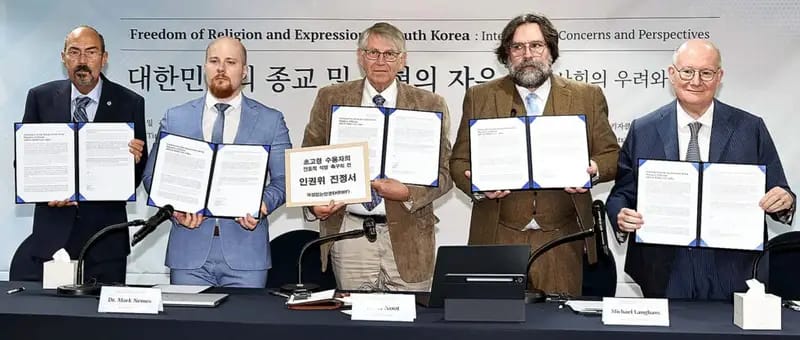
A coalition of international human rights organizations held a press conference Friday at the Seoul Foreign Correspondents’ Club, raising concerns about freedom of religion or belief and freedom of expression in South Korea.
The event was organized by Human Rights Without Frontiers (HRWF), CAP Liberté de Conscience (CAP LC), which holds ECOSOC accreditation at the United Nations, FOREF, CESNUR and Bitter Winter.
Speakers focused on the treatment of elderly religious leaders held in pretrial detention, raising questions of proportionality, humanitarian considerations and due process.
The organizations called on South Korean authorities to review the detention of Shincheonji Chairman Lee Man-hee, 95, and urged that the legal and administrative response to religious minorities remain neutral, proportionate and consistent with South Korea’s international human rights obligations — including with respect to Hak-ja Han Moon, 83, of the Family Federation.
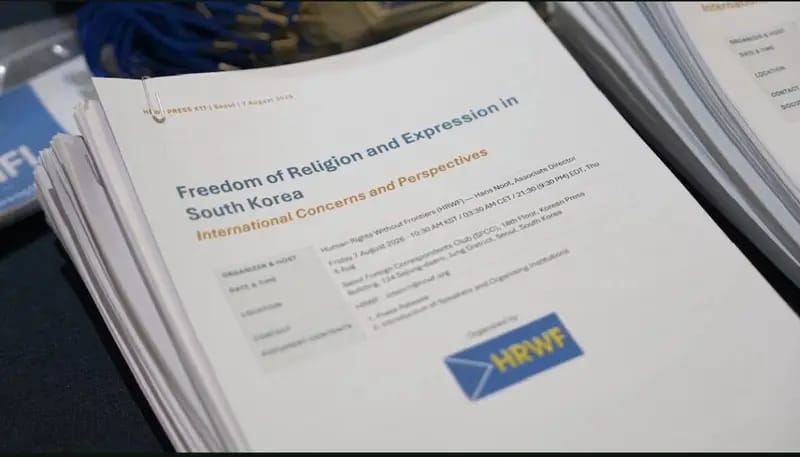
Organizers said the concerns fit a broader pattern of freedom of religion or belief issues in the country. They pointed to continued harassment and official scrutiny of Segero Church in Busan even after Pastor Son Hyun-bo was released from detention, as well as reporting on conscientious objection, public opposition to a mosque project in Daegu, and questions of religious accommodation in schools.
HRWF said it has documented the imprisonment of hundreds of Jehovah’s Witnesses in South Korea as conscientious objectors over past decades. While an alternative civilian service program was later introduced, critics say it has functioned punitively rather than as a genuine rights-respecting alternative, requiring 36 months of service in correctional facilities — twice the length of regular military service. Recent court rulings have upheld key features of that system against constitutional challenge.
Opening the conference, Hans Noot, Associate Director of HRWF, said the issues at stake “lie at the heart of democratic society.” He warned that when religious communities are stigmatized and peaceful gatherings are restricted, dissent comes to be treated as a problem to be contained, with consequences that “extend far beyond any single group or case.” He said the conference was not about defending any particular theology or movement, but about “defending a principle: that fundamental rights apply equally to all.”
Thierry Valle, President of CAP Liberté de Conscience, addressed the legality of Chairman Lee’s detention under international law. Citing South Korea’s ratification of the International Covenant on Civil and Political Rights in 1990 and the Convention against Torture in 1995, he questioned whether placing a 95-year-old in pretrial detention is consistent with those obligations. He said the presumption of innocence must prevail over any presumption of guilt, and that democratic countries have alternative, more proportionate and humane measures available that respect both the presumption of innocence and human dignity. He cited precedents including Cardinal Joseph Zen’s 2022 release on bail in Hong Kong and Vietnam’s decision to place Buddhist Patriarch Thich Quang Do under house arrest rather than imprisonment.
Michael Langhans, Executive Director of FOREF Germany, presented a legal analysis questioning whether pretrial detention was necessary given evidence he said was already sufficient for an indictment, and whether that evidence had been gathered neutrally rather than through a narrative framing the defendant’s community as a “sect” or “cult.” He said the case raises a broader question for lawmakers: whether measures intended to protect fair elections can be applied without nullifying the constitutionally and internationally guaranteed right to freedom of religion.
Márk Nemes, Deputy Director of CESNUR, discussed the effects of ongoing persecution and its possible ramifications for minority faiths. He cited three recent scholarly investigations of Shincheonji congregations in Europe, Argentina and Australia, each finding a worrisome increase in hostility toward what he described as an otherwise peaceful and cooperative religious movement. He said Shincheonji is not simply a South Korean minority church but a global movement, and that disproportionate persecution in South Korea affects congregants abroad whose rights under Articles 18 and 19 of the ICCPR must be considered in the current process.
ALSO READ : YOWICAN Chairman Urges Christian Youths to Rise Beyond Division, Corruption, Violence
Massimo Introvigne, Managing Director of CESNUR and Editor-in-Chief of Bitter Winter, said South Korea “has crossed a worrying line” in arresting Chairman Lee, arguing that international standards such as the Mandela Rules would call for house arrest rather than imprisonment for a 95-year-old accused of a non-violent offense. He said the charges, tied to ordinary political participation by members of a religious minority, “appear legally and conceptually overstretched,” and warned the case fits a broader pattern of pressure against minority faiths in the country.
The organizations called on South Korean authorities, the media and the international community to examine these developments with close attention to due process, proportionality and equal protection of fundamental rights, and said they had made further documentation available to support continued reporting.
At the conclusion of the press conference, scholars in attendance signed a letter calling on the government of the Republic of Korea to immediately release Chairman Lee from custody.
ALSO READ
Rwandan President Paul Kagame Challenges Church Leaders Over Failure to Fulfill Religious Duties
Discover more from THE BAPTIST CHRONICLE
Subscribe to get the latest posts sent to your email.